Crash Course Study Skills

Instructor
CrashCourse
- Description
- Curriculum
- Reviews
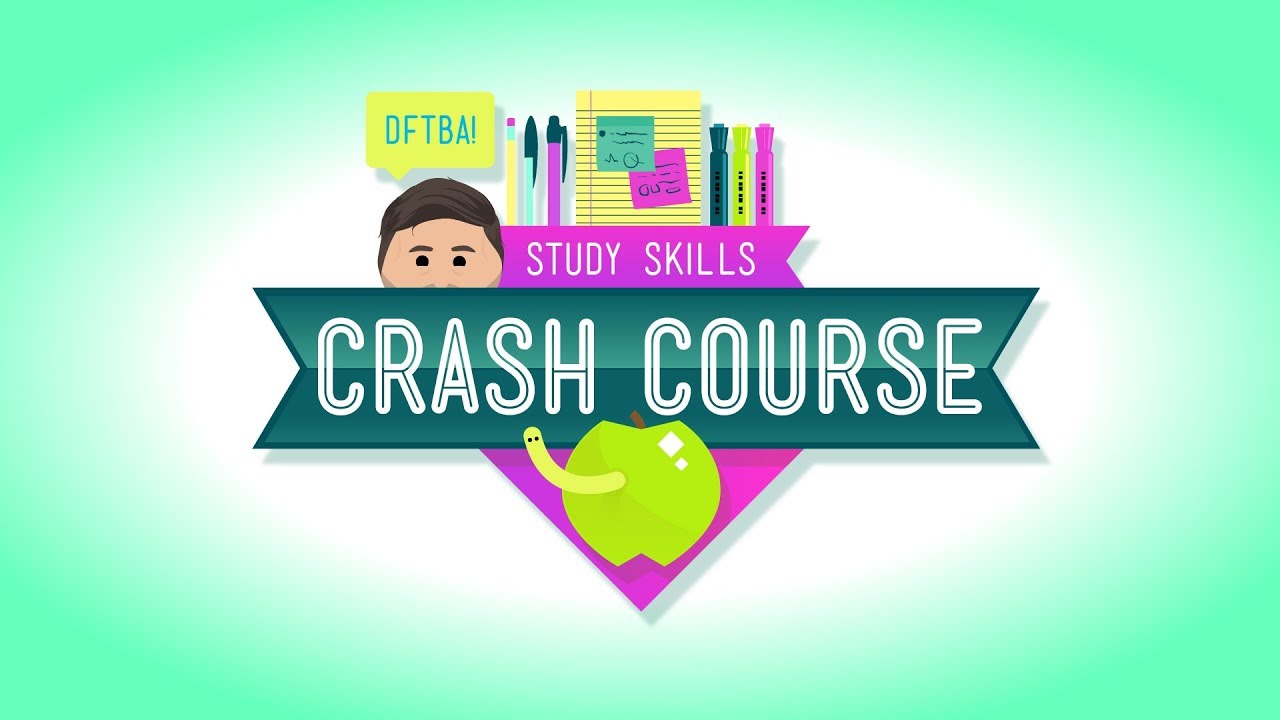
Welcome to Crash Course Study Skills! Over the next 10 episodes, Thomas Frank is going to help you learn to be a better student. We’ll go over study tips, note-taking, getting organized, and so much more!
Thomas around the web:
http://www.youtube.com/ThomasFrank
Study Skills
-
1
 Taking Notes
The first step in honing your new study skills is to take better notes. This week Thomas will tell you everything you need to know to come to class prepared and find a note-taking system that will help you retain and review like a champ.
Resources:
Study on computer vs. paper note-taking: http://journals.sagepub.com/doi/pdf/10.1177/0956797614524581
Evernote: https://evernote.com/
OneNote: https://www.onenote.com/
Dropbox Paper: https://paper.dropbox.com
Coggle (mind-mapping tool): https://coggle.it/
-
2
Reading Assignments
Leaving the bookstore at the beginning of the semester you’re probably wondering how the heck you’re going to get through all of that reading. Today we’re explaining how much of that reading you really need to do and the best strategies for making your way through it.
Resources:
Cal Newport – How to Become a Straight-A Student – https://www.amazon.com/dp/B000MAHBYQ/
The Science of How Fast Humans Can Read – https://collegeinfogeek.com/speed-reading-science/
An Examination of Speed Reading Techniques – https://collegeinfogeek.com/speed-reading-techniques-examined/
Elizabeth Schotter’s research summary on speed reading – http://journals.sagepub.com/stoken/rbtfl/0GSjhNaccRKTY/full
The Art of Pseudo-Skimming – http://calnewport.com/blog/2008/02/25/monday-master-class-the-art-of-pseudo-skimming/
The Morse-Code Method – http://calnewport.com/blog/2008/02/18/monday-master-class-rapid-note-taking-with-the-morse-code-method/
SQ3R – https://en.wikipedia.org/wiki/SQ3R
-
3
Memory
An essential part of learning and studying is remembering things, so this week Thomas explains some of how your memory works so that you can spend less time working against your memory’s limitations and more time playing to its real strengths.
Resources:
How We Make Memories: Crash Course Psychology #13
The Magical Mystery Four: How is Working Memory Capacity Limited, and Why?: https://www.ncbi.nlm.nih.gov/pmc/articles/PMC2864034/
How to Remember More of What You Learn with Spaced Repetition (includes more detail on the Leitner System): https://collegeinfogeek.com/spaced-repetition-memory-technique/
Herman Ebbinghaus’ original memory study: http://nwkpsych.rutgers.edu/~jose/courses/578_mem_learn/2012/readings/Ebbinghaus_1885.pdf
The Owner’s Manual for the Brain by Pierce J. Howard: https://www.amazon.com/Owners-Manual-Brain-4th-Performance/dp/0062227351
How We Learn by Benedict Carey: https://www.amazon.com/How-We-Learn-Surprising-Happens/dp/0812984293
-
4
Planning & Organization
The best way to make sure you’re making the most of the time you have is to start off well organized. This week we’re talking about planning and organizational systems and how to set yourself up for success.
Resources:
Planning Mode vs. Robot Mode: https://collegeinfogeek.com/procrastination-eliminate-choices/
Todoist: https://todoist.com/
Microsoft To-Do: https://todo.microsoft.com/
Trello: https://www.trello.com
Any.do: https://www.any.do/
Bullet Journal: http://bulletjournal.com/
Google Calendar: https://calendar.google.com
Evernote: https://evernote.com/
OneNote: https://www.onenote.com/
More detail on Thomas’ actual folder structure: https://collegeinfogeek.com/organizing-school-files-and-notes/
-
5
Focus & Concentration:
Have you ever noticed how easy it is to get distracted while studying – even when you know you really don’t have time for Facebook, Snapchat, Cookie Clicker, or whatever else is calling you? This week we’re going to help you get a better handle on your focus and concentration and how to improve those skills.
Resources:
Bottom-up and top-down attention: different processes and overlapping neural systems: https://www.ncbi.nlm.nih.gov/pubmed/24362813
How to create a dedicated study space in your room: https://www.youtube.com/watch?v=0JDkNOSUK1w
Cold Turkey: https://getcoldturkey.com/
StayFocusd: https://chrome.google.com/webstore/detail/stayfocusd/laankejkbhbdhmipfmgcngdelahlfoji?hl=en
Forest: https://www.forestapp.cc/en/
Why Breaks are So Important: https://www.youtube.com/watch?v=TkraRj8uAYQ
Deep Work by Cal Newport: http://calnewport.com/books/deep-work/
-
6
Procrastination
You’re here right now, but you should probably be studying or writing that research paper. But as long as you’re here, we’re going to help you figure out how to get the better of your desire to procrastinate in the future. Just don’t forget about us when you fully master your procrastination, OK?
Resources:
An in-depth discussion on the Procrastination Equation: https://www.youtube.com/watch?v=V0neHmyws3I
The Pomodoro Technique: https://en.wikipedia.org/wiki/Pomodoro_Technique
Habitica: https://habitica.com
High-density vs. low-density fun: https://www.youtube.com/watch?v=Efr9II6mS3I
Cold Turkey app: https://getcoldturkey.com/
-
7
Studying for Exams
It turns out that saving all of your studying until after midnight on the night before your big exam is not actually a great way to prepare. Today, Thomas explains some test prep strategies that actually work.
Resources:
Koofers test bank: https://www.koofers.com/testbank
Context-dependent memory study: http://www.niu.edu/user/tj0dgw1/classes/411/GoddenBaddeley1975.pdf
How to make great flashcards: https://www.youtube.com/watch?v=mzCEJVtED0U
The Corson Technique: https://collegeinfogeek.com/corson-technique/
-
8
Test Anxiety
Exams can be terrifying. It’s easy to feel like the weight of the world rests in these moments – like this one test determines your grades and, in turn, your whole future – even if you know, rationally, that this isn’t really the case. What’s worse is that this fear and anxiety can make you do worse on the test. So, take a deep breath, and let us walk you through some tips for beating test anxiety so that you can walk in on test day feeling refreshed and confident.
Resources:
Writing About Testing Worries Boosts Exam Performance in the Classroom: http://science.sciencemag.org/content/331/6014/211.full
The War of Art by Steven Pressfield: https://www.goodreads.com/book/show/1319.The_War_of_Art
-
9
Papers & Essays
Writing research papers is an essential skill in your career as a student, and this week we’re going to help you do that like a pro. From figuring out where to begin, to finding the best systems, to breaking out of the “research recursion system” (maybe just figuring out what that means), we’ve got you covered.
Resources:
How to Write a Great Research Paper by Simon Peyton Jones: https://www.youtube.com/watch?v=g3dkRsTqdDA
How to Become a Straight-A Student by Cal Newport: https://www.goodreads.com/book/show/253203.How_to_Become_a_Straight_A_Student
Close Reading and Research: https://collegeinfogeek.com/writing-close-reading-research/
Writing and Editing Tips: https://collegeinfogeek.com/essay-writing-and-editing/
-
10
Exercise
We’re finally to the end of our time together here on Crash Course Study Skills, so this week we’re taking a more holistic approach to becoming the best learner you can be. Part of taking care of your brain is taking care of your whole body, of which your brain is a part. We’re wrapping up this course by outlining some good tips and tricks for maintaining a healthy body, and why it’s such an important part of being a great student.
Resources:
Spark: The Revolutionary New Science of Exercise and the Brain by Dr. John Ratey: https://www.goodreads.com/book/show/721609.Spark
Thomas’ interview with Dr. John Ratey: https://www.youtube.com/watch?v=A8NxS9yAkeY
More on sea squirts: https://www.psychologytoday.com/blog/choke/201207/how-humans-learn-lessons-the-sea-squirt
Please, login to leave a review